Problem
When learning compiler fundamentals, it’s hard to see how C source code becomes tokens and how grammar rules validate structure. I wanted a practical desktop tool that makes lexing/parsing more tangible with immediate feedback.
What I built
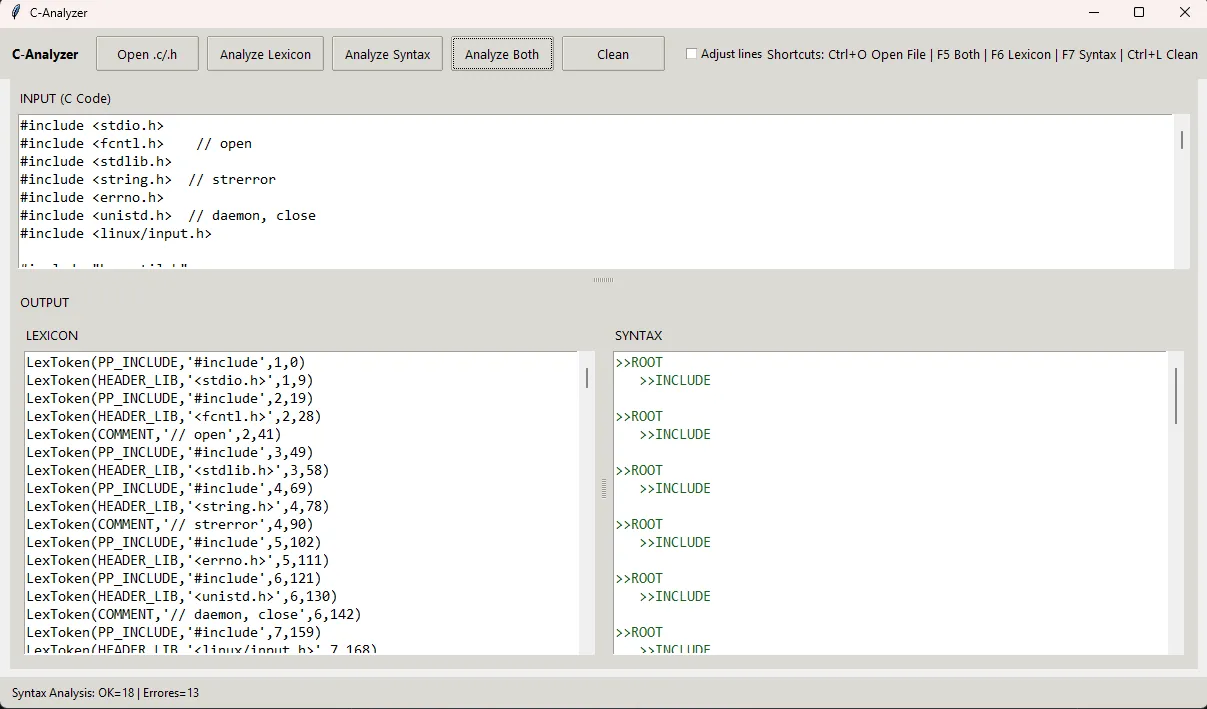
A Tkinter desktop app that:
- Lets you paste C code in an input editor
- Produces a token stream (lexer output)
- Runs syntax parsing using a custom grammar (subset of C)
- Prints a readable, tree-like representation of recognized rules (or clear syntax errors)
Highlights
- Lexer coverage: common C keywords, identifiers, numbers, strings, operators, preprocessor directives, and more.
- Parser coverage (subset):
if/else,for,while,switch/case, declarations, assignments, expressions, arrays, and function declarations. - More robust input handling: ignores inline comments (
// ...) for syntax checks and skips unsupported lines liketypedef/staticdeclarations so the analyzer can focus on the supported grammar. - Packaging improvements:
pyproject.toml,__init__.pymodules, and a cleaner runnable entry (renamedscreen.py→app.py).
Architecture
analyzers/lexicon.py: lexer rules + token definitions (PLY Lex)analyzers/syntax.py: grammar rules + parser (PLY Yacc)ui/app.py: Tkinter UI + wiring (analyze lexicon / syntax / both)assets/: UI assets (if present)
How to run
Option A: Install as a package (recommended)
# from the repo root
pip install -e .
# or, if you have dev extras configured:
# pip install -e ".[dev]"
Run the UI:
python -m ui.app
# or
python ui/app.py
Option B: Minimal dependencies
pip install ply
python ui/app.py
Usage
- Paste C code into the INPUT panel or select a file
- Click
- Analyze Lexicon to see tokens,
- Analyze Syntax to parse supported grammar,
- Analyze Both to run both steps.
📷 Screenshots